
Performance plans create results—or resentment. The fastest path to compliance is punishment: public call-outs, quota threats, pay withheld. It works, briefly. Then engagement drops, attrition rises, and the best people quietly leave.
There’s a better way. Drawing on Organizational Behavior Management (OBM), we built a simple system that ties controllable role metrics to a stepwise target ladder, assigns weights that mirror strategy, and pays out fast when teams make progress. The effect: higher clinical quality, fewer cancellations, and lower attrition—without fear tactics.
There’s a better way. Drawing on Organizational Behavior Management (OBM), we built a simple system that ties controllable role metrics to a stepwise target ladder, assigns weights that mirror strategy, and pays out fast when teams make progress. The effect: higher clinical quality, fewer cancellations, and lower attrition—without fear tactics.

To fully grasp why this works, we first need to understand positive reinforcement and punishment respectively. This blog goes into the impact and benefits of using positive reinforcement in detail. Basically, positive reinforcement is adding something to someone’s environment that makes seeing a behavior more probable in the future. For example, if someone likes praise then say “good job” when they do something productive at work. The words “good job” may act as positive reinforcement for that person, which increases the likelihood of that person continuing to exhibit the same behavior which earned praise.
Positive punishment on the other hand is adding something aversive to someone’s environment to decrease the likelihood of someone repeating an undesired behavior again. When I was early in my career, I had a really terrible manager who would scream at me for making a mistake. The screaming was aversive (punishing) to me, and I didn’t make the same mistake again for a long time. However, I did almost resign and lowered my discretionary effort at work.
Luckily, I came across a senior leader who had a different approach that unknowingly convinced me to stay. I will never forget Kevin. The first time I met him, he smiled, shook my hand, and praised me for coaching a severely under-performing employee to exceed expectations in every metric in just a few months. The praise was reinforcing to me, and I found myself investing even more time coaching others in the future.
See where this is going? Positive reinforcement increases the future likelihood of behavior occurring again. It might take time, but the long-term impacts are real. Punishment might get us where we need to be sooner, but for all the wrong reasons, and with serious negative implications. The same approach we take in modern ABA in our young learners applies to all of us in the work environment.
Positive punishment on the other hand is adding something aversive to someone’s environment to decrease the likelihood of someone repeating an undesired behavior again. When I was early in my career, I had a really terrible manager who would scream at me for making a mistake. The screaming was aversive (punishing) to me, and I didn’t make the same mistake again for a long time. However, I did almost resign and lowered my discretionary effort at work.
Luckily, I came across a senior leader who had a different approach that unknowingly convinced me to stay. I will never forget Kevin. The first time I met him, he smiled, shook my hand, and praised me for coaching a severely under-performing employee to exceed expectations in every metric in just a few months. The praise was reinforcing to me, and I found myself investing even more time coaching others in the future.
See where this is going? Positive reinforcement increases the future likelihood of behavior occurring again. It might take time, but the long-term impacts are real. Punishment might get us where we need to be sooner, but for all the wrong reasons, and with serious negative implications. The same approach we take in modern ABA in our young learners applies to all of us in the work environment.
Performance Management Systems
There are evidence-backed performance thinking systems out there such as Carl Binder’s 6 boxes system. In Carl’s system, there are six areas of focus:
It’s a good holistic system to ensure performance is well-managed.
If performance isn’t meeting expectations, going through each area to identify where the issue is can help ensure your performance management is holistic. The Performance Diagnostic Checklist (PDC) is a great diagnostic tool for pinpointing specific issues to address.
Let’s build our own evidence-backed performance management system, and we’ll explore the rationale why this is effective.
The OBM Alternative: Reinforcement at Scale
Organizational Behavior Management (OBM) offers a better way. By focusing on reinforcement instead of punishment, leaders can design systems that produce results and sustain culture. We built a simple framework that ties controllable role metrics to stepwise targets, assigns weights that mirror strategy, and pays out quickly when progress is made.
Performance Management: Goal Selection
Different positions in an organization will have different goals or Key Performance Indicators (KPIs) and associated behaviors. Goals are important to an organization and should drive the organization forward. Goals can be delivering a project or service, or meeting a KPI to ensure existing offerings are functioning within limits. A few considerations on goal selection:
Picking goals that are important to the organization, breaking them down for individual positions, and making expectations clear is good management. Next we need to set targets - the quantifiable numbers.
Performance Management: Laddered Target Setting
Starting with setting organizational goals, we need a few things:
Your organizational goals might look something like this:
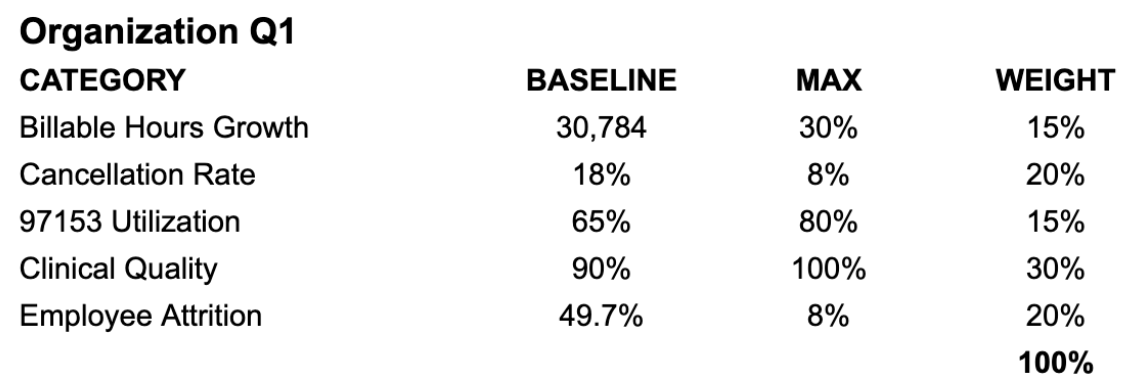
Then we break down the organizational goals into goals for different departments or positions/people. For a CD in a specific location, their goals might look like the below:

Notice the baseline data is specific to the area that specific person is responsible for? That ensures they have more control over things. Although they can’t directly stop a family or staff member from canceling, they can do things to help achieve that goal. For example, giving feedback to a family that cancels a lot to explain why attending sessions regularly is so important. They also can’t stop a staff member from quitting, but they can manage the environment to create better working conditions.
Performance Management: Weight That Matters
Leaders allocate attention through weighting. Each KPI is weighted to reflect strategic importance. For example:
All of the above are for just one position. You’ll want to go through a similar exercise to set targets for other positions, such as Operations team members. Remember, all their goals are broken down from the organizational goals already set above. Repeat for each position.
Performance Management: Calculating a Score
Calculating a score should be easy. You’ll want to do this at least quarterly, if not more frequently. Making someone wait a year to contact reinforcement isn’t effective. To calculate the score, look at the results. In our Clinical Director (CD) example, let’s review the data at the end of the quarter:

You can see from the table that:
Now for some light math:
Performance Management: Contacting Reinforcement
Now it’s time to reward your team. Communicate the organization’s solid progress with them so the benefits are shared with everyone that contributed. The communication is reinforcing, and so are the financial benefits:
Structuring report-outs from employees is an incredibly effective way to incorporate self-monitoring to encourage performance and boost accountability. They can self-track and report out in supervision sessions, team meetings or other settings. This helps keep them on track, and can also be a form of reinforcement.
If done correctly, a pay for performance system can result in staff being aligned around similar goals, all working together to drive performance. Organizations that have implemented this have often been able to lower base salaries for staff once staff realize they can make a higher take home pay by working in this system. Make sure to pay people as soon as possible once the performance data is available, so they contact reinforcement sooner. Don’t forget to walk them through the dollar amount and why results landed where they did. For more frequent reinforcement, track progress along the way and share it with people.
If done correctly, a pay for performance system can result in staff being aligned around similar goals, all working together to drive performance. Organizations that have implemented this have often been able to lower base salaries for staff once staff realize they can make a higher take home pay by working in this system. Make sure to pay people as soon as possible once the performance data is available, so they contact reinforcement sooner. Don’t forget to walk them through the dollar amount and why results landed where they did. For more frequent reinforcement, track progress along the way and share it with people.
Performance Management: Adjusting Baselines
Defining measurable organizational objectives, with SMART goals for different positions/people can set clear expectations about performance that drives results. Aligning individual goals to organizational outcomes keeps everyone moving towards strong organizational performance. Ensuring people contact positive reinforcement regularly and are rewarded for contributing results that improve the organization, while resetting baselines, enables the organization to continuously improve and share financially with employees. There’s nothing that’s negative or punishing about this system. This can also help build trust and transparency from leadership, just like all those great managers we’ve had before.
ABA practice owners can reach out for support any time. We don’t do paid consulting, and are simply happy to have conversations with like-minded BCBAs trying to improve the field.
Jamie Turner
MBA, PMP, BCBA