
Organizations don’t fail from lack of effort—they fail from unclear processes and expectations. Organizational behavior management (OBM) is the application of behavioral science that Board Certified Behavior Analysts (BCBAs) know and love, applied to workplace performance. Maria Malott defined a process as “a series of tasks - from a few to a hundred or even thousands - performed to accomplish a specific purpose” (Paradox of Organizational Change, 2003 p. 100). Process mapping involves defining a process, and visualizing it. Clear process maps align behavior, reduce variability, and improve workplace outcomes.
In the OBM context, a process map is a visual representation of workflows, an Applied Behavior Analysis (ABA) task analysis, behavioral expectations, and potentially the owners of each step of a process. It doesn’t just indicate what behavior happens, but outlines sequential steps, decision points, and an outcome (permanent product) at the end. Each process has a clear start and end point. Key components of a process include:
As an ABA practice grows, it becomes essential to document processes. One BCBA cannot possibly know every step in every process in a medium or large sized practice. Documented processes have many benefits, including:
BCBAs know well how difficult the Scheduling role is. Pairing technicians with appropriate clients, looking ahead to plan for things like school closures, and day-to-day cancellations while keeping everyone happy is challenging to say the least. At Acclaim Autism, there’s a simple process that’s followed when a parent cancels a session. There are documented policies and procedures, but sometimes that’s not enough. Some Schedulers and even BCBAs are more receptive to visual job aids; this helps with training too. A simple process map should replace an overly-complex Standard Operating Procedure (SOP). Here’s a sample process map for when a parent cancels a session:
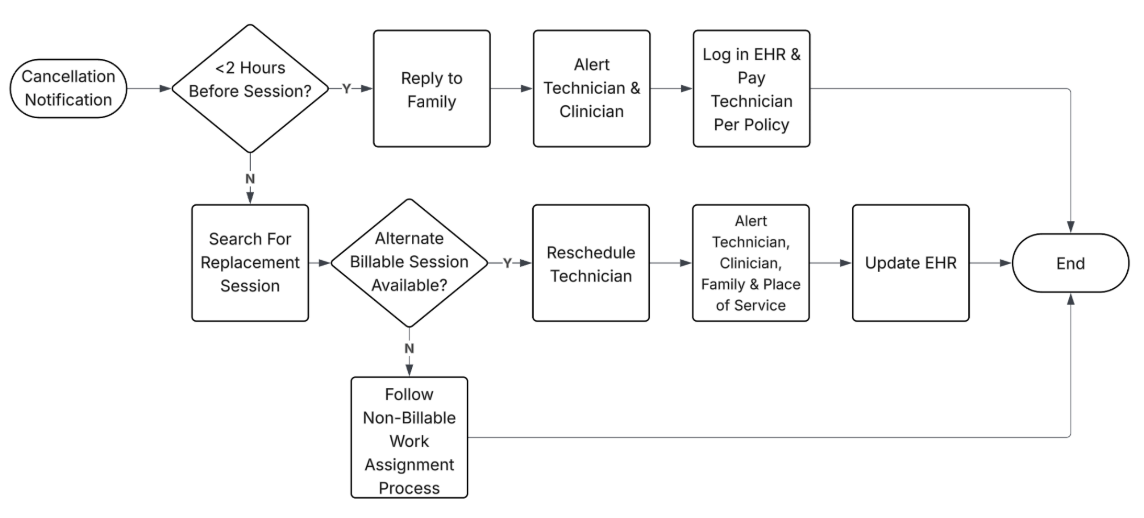
This process chart can help visualize for a Scheduler what steps they need to take. There is a clear beginning to a process, which starts when a family cancels a session. The triangle shape indicates a decision point to guide the Scheduler what to do next. The squares represent behavior steps. Outlining this in a map can also increase accountability so a supervisor can point out if a step is missed, or better yet, reinforce cancellations where each step was followed correctly per this job aid.
An important part of managing a process is feedback and reinforcement. In our cancellation process map above, the end result is one or more updated sessions in the Electronic Health Record (EHR), including documentation of the cancellation as the output (permanent product). This data should appear on reports and be monitored regularly as feedback into cancellation trends. Feedback should also be given to the scheduler, ideally in a way that’s reinforcing to them.
There are core elements of a well-designed process map:
There are core elements of a well-designed process map:
1. Behavior-Level Detail
a. Focus on observable, measurable actions
b. Avoid vague steps such as “follow up with client”
2. Decision Points
a. Yes/no or If/then logic clearly defined
3. Simplicity & Usability
a. Don’t overcomplicate a process map
b. Maps should be usable, not just impressive
4. Clear Ownership (more on this next)
a. Focus on observable, measurable actions
b. Avoid vague steps such as “follow up with client”
2. Decision Points
a. Yes/no or If/then logic clearly defined
3. Simplicity & Usability
a. Don’t overcomplicate a process map
b. Maps should be usable, not just impressive
4. Clear Ownership (more on this next)
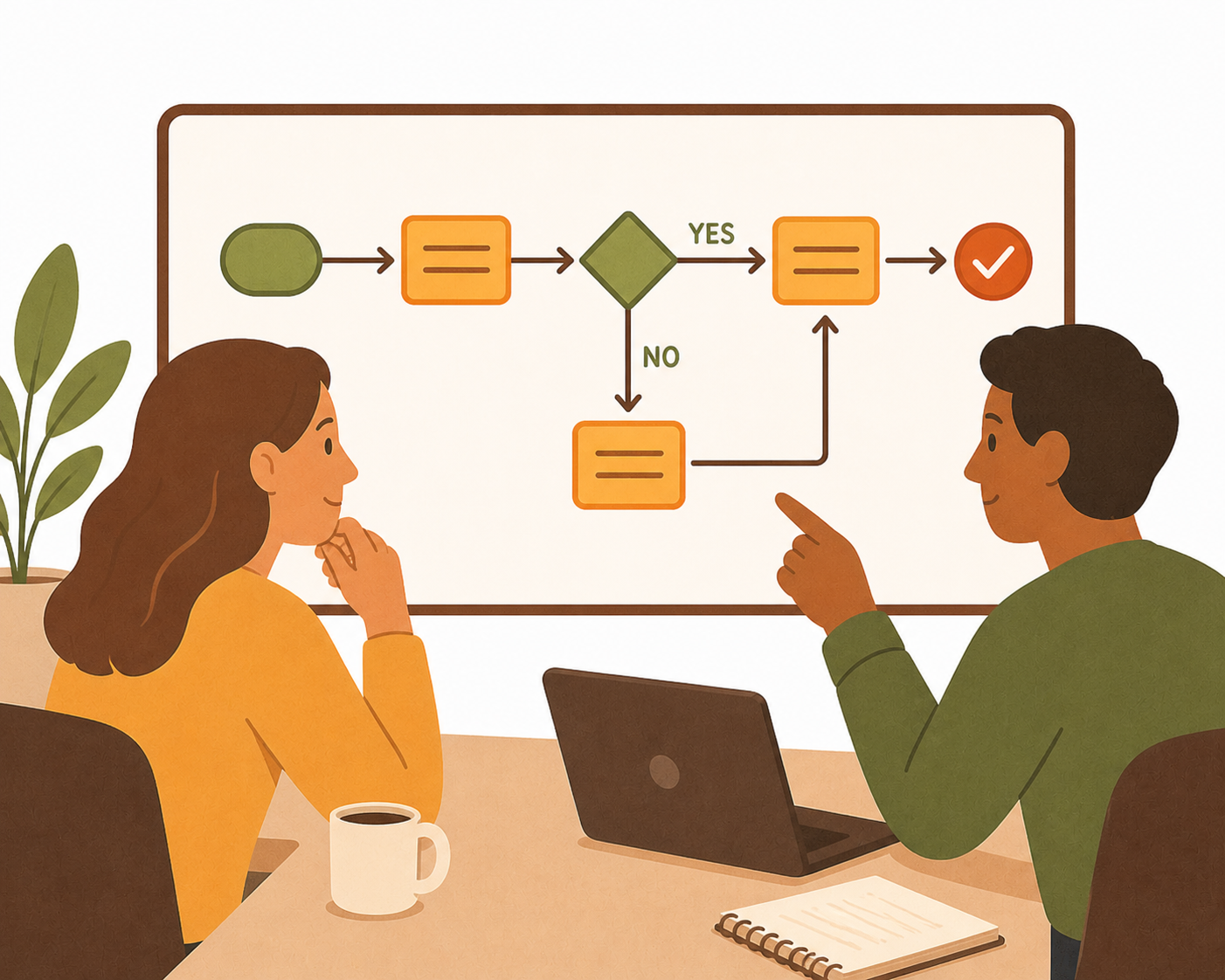
In the first example, the Scheduler executed the whole process, communicating with other people at various steps. More complex processes can involve multiple people or teams that have behavior steps assigned to them as part of a larger process. For example, when a parent applies for services for their child, an Intake Specialist goes through a series of behavior steps but can’t do everything. A BCBA needs to provide clinical input as to the clinical fit of staff for the client’s particular needs, the parent has a big part to play, and someone else might be responsible for the insurance pieces that knows a lot about insurance. Here’s a sample process map that includes ‘swimlanes’ to identify various owners of each step:
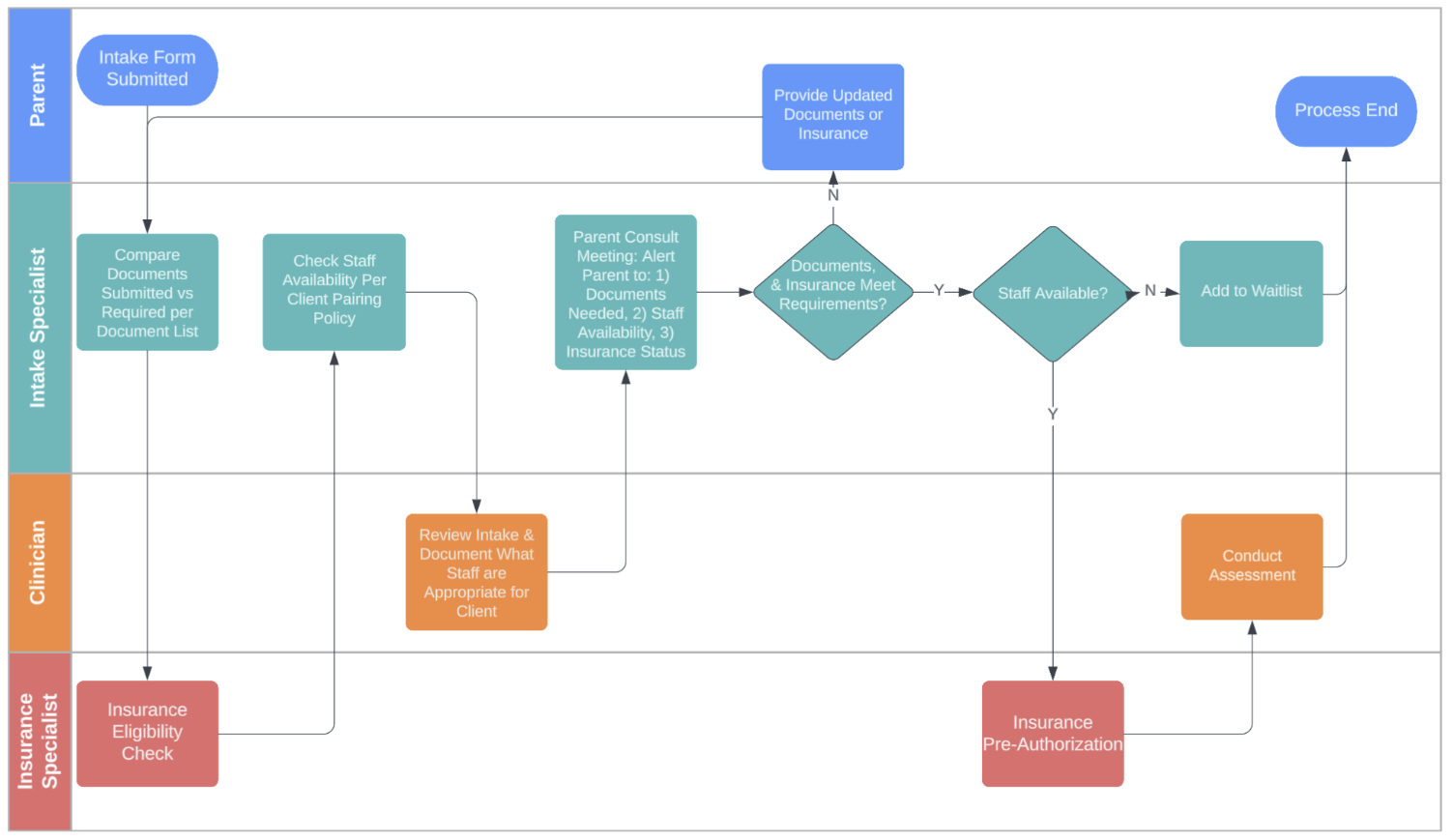
There are four swimlanes indicating four different people or teams that have a role to play in reviewing a parent’s request for services for a potential new client:
- Parent (indicated in blue): the parent submits an intake application including supporting documents, and might need to submit additional documents later in the process.
- Intake Specialist (indicated in green): this person has the most behavior steps; they review the intake form and submit documents against documented requirements. This list of documents should be accessible to the Intake Specialist. They have a lot more work to do as we follow the process.
- The Insurance Specialist (indicated in red): this person checks a parent’s insurance, and later might need to get a pre-authorization for an assessment.
- Clinician (indicated in orange): this person reviews a case for clinical fit; the output of this step is an input to the Intake Specialist’s parent consult meeting.
ABA companies have different variations of this process depending on how they’re organized. With variation from company to company, it’s important to document how your company operates to help train others and ensure the process is running smoothly. The end of this process produces some kind of output (permanent product). This is either a new client on the waitlist, or a new client in an assessment. This output will likely be input to another process:
Your company could have dozens or even hundreds of process maps that are interconnected through hyperlinks. Together, these processes work to produce a product or service, such as ABA therapy.
Making a process map is simple. Once it’s mapped, you can look for ways to improve a process that might not produce the desired outcomes. Here are some steps you can follow:
Try to avoid some common mistakes. Overcomplicating the process, ignoring actual current-state behavior, and failing to involve frontline staff or people actually doing the work. When you map a process, you are visualizing something that already exists and then trying to improve it. When done, link the process to training and performance management to ensure ongoing effectiveness.
Systems drive behavior, and behavior drives outcomes. Visualizing these systems in the form of process maps helps train staff, set clear expectations, and drive better workplace outcomes. If you’re new to this, start with one process: map it at the behavioral level, gather feedback, and improve it. Use it to drive measurable improvement tied to organizational outcomes.
ABA practice owners can reach out for support any time. We don’t do paid consulting, and are simply happy to have conversations with like-minded BCBAs trying to improve the field.
OBM@acclaimtraining.com
OBM@acclaimtraining.com
Jamie Turner
MBA, PMP, BCBA