
I interviewed a Board Certified Behavior Analyst (BCBA) who owned her own ABA therapy practice. She had a team of talented technicians, a stable client base, and strong clinical quality in her organization. Why was she applying to be a BCBA at my company? She was finding it unmanageable to navigate all the complexities of running a business while keeping staff, families, and payers happy, and she needed another path to pay her bills and potentially exit her company.
It’s fair to say BCBAs have to balance more things than many professionals: training staff, providing supervision, managing a caseload, ensuring compliance, and so much more. We take the duty of care seriously. Parent phone calls, IEP meetings, the list of non-billable things goes on. Many of us get frustrated with employers enough to start our own practice, only to realize the workload is even greater. With good intentions of focusing more on clinical quality, the time for that gets less and less as we get deeper into running a practice. That’s where Organizational Behavior Management (OBM) systems design steps in to help.
Implementing behavioral systems with an OBM framework is useful for so many things, including:
Implementing behavioral systems with an OBM framework is useful for so many things, including:
It’s too easy to get bogged down in hiring and caseload oversight. We all entered this field with good intentions and don’t want to lose sight of the kids. However, it’s our ethical and legal obligation to ensure all services are provided with fidelity, including proper oversight. As an agency grows, it gets harder for one person to do that. Delegating to others is effective, but it needs systems to provide effective oversight without anyone burning out. OBM can be used at the organizational level to monitor performance. It starts with pinpointing the behavior or result you need to manage.
Keep things simple with 2-3 data points or Key Performance Indicators (KPIs) for function. Be specific as though setting goals for a client with objective criteria. Such a list can include:
Keep things simple with 2-3 data points or Key Performance Indicators (KPIs) for function. Be specific as though setting goals for a client with objective criteria. Such a list can include:
Once KPIs are established, it’s a matter of training an administrative person on where to pull the data and log it on a regular cadence. Acclaim Autism logs this data weekly, including graphing the data. When a BCBA business owner has regular access to this data, it becomes easier to manage the practice. Reviewing graphs regularly with team members and other BCBAs makes people aware of the data. If a KPI isn’t meeting expectations, the BCBA can have a conversation with the appropriate people to course correct. An OBM intervention can be used if needed.
As the practice grows, a pay for performance (PFP) system can help to reward people for the great work they do, while also making them aware of their performance vs expectations. Positive reinforcement is most effective at driving sustained long-term results that capture an employee’s discretionary effort.

There’s so much opportunity for positive reinforcement:
Once data is graphed and shared regularly, and pay for performance systems are rolled out, the organization should be running well. As the practice grows and complexity increases, don’t lose sight of these systems. Using OBM data at the organization level is still your role. As you start to hire people to manage other functions, such as training, or maybe a Center Director, teach them this same system that you use. Your KPIs at the organizational level should be broken down into their goals for their respective departments. Department managers can hold regular meetings for their departments to review their data and their teams’ progress.
As growth continues, you will need to establish and document processes. Think of a process like a behavior chain. It’s a step of repeatable behaviors someone needs to follow in order to achieve a desired output. For example, when you find a new staff member you want to hire, your offer process could look like this:
Of course, as the practice grows, some KPIs will remain, and some may need to change. Regulations change, and priorities can shift. Keep a core group of metrics consistent so your company has that continuity and clarity of expectations, but don’t be scared to update a KPI as needed. Resetting baseline targets as performance improves, and swapping KPIs to measure different things throughout growth are best practices. This is just like updating a client’s program as they meet mastery criteria. For an OBM system to run, give a person or team clear ownership of logging and graphing data, and review it regularly, no matter how busy you get.
As growth continues, you will need to establish and document processes. Think of a process like a behavior chain. It’s a step of repeatable behaviors someone needs to follow in order to achieve a desired output. For example, when you find a new staff member you want to hire, your offer process could look like this:
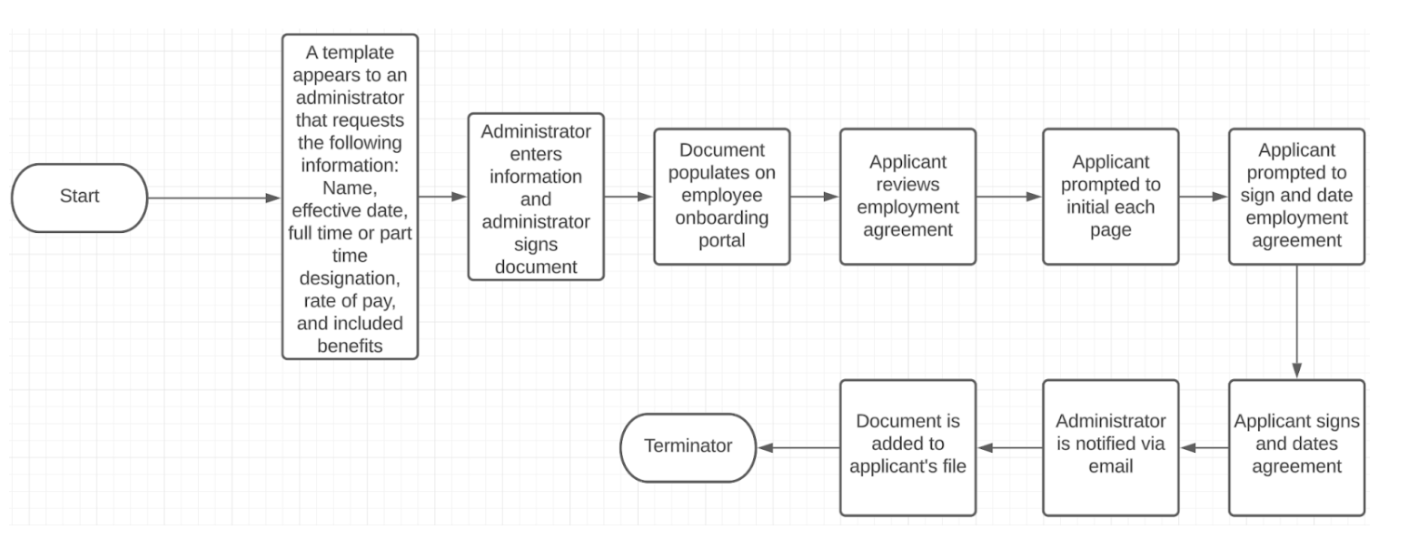
This visual job aid helps others to follow the process without missing a step. Also document them in writing for clarity and establish criteria for each behavior step. It can also be used for process quality control if you find the process is not producing the desired outcome. With documented processes, you can ask an administrative person to periodically review the steps in a process and score someone’s behavior against a scorecard - another chance for positive reinforcement when things are working well. Next month we will review process mapping and documentation. As your practice grows, you will need a lot of processes, including:
A rigid process for things like compliance is crucial. As regulations increase, you can add to your existing processes. Once your practice has grown substantially, you may have dozens or even hundreds of processes. We will dive more into processes and Behavioral Systems Analysis (BSA) in a future blog.
ABA practice owners need to implement systems and processes; they can’t do all the managing themselves, and aren’t the only ones who manage people. Systems should reward, and punishment should be brought in when methods of coaching, support, and tool provision have failed. Systems can identify problems such as attendance issues and high cancellation rates, allowing people to manage those issues individually. Practice owners can reach out for support any time. We don’t do paid consulting, and are simply happy to have conversations with like-minded BCBAs trying to improve the field. OBM@acclaimtraining.com
Jamie Turner
MBA, PMP, BCBA